

Most interviews draw on the same small set of questions. If you prepare these twenty, with real examples from your work, very little will catch you off guard. For each one, here is what the interviewer is really trying to learn and a structure for your answer.
Opening questions
1. Tell me about yourself.
What they want: a two-minute summary that connects your experience to this role. Structure: present, past, future. What you do now, what led you here, and why this job is the next step. Full examples by role are in how to answer “Tell me about yourself”.
2. Why do you want to work here?
What they want: proof that you chose this company on purpose. Structure: one specific thing about the company (a product, a customer, a value), one link to your experience, one thing you want to learn.
3. Why are you leaving your current job?
What they want: a forward-looking reason, not a complaint. Structure: what you have achieved, what you are looking for next, and why this role offers it.
4. What do you know about our company?
What they want: evidence of preparation. Structure: what they do, who they serve, one recent change, and why it matters to the role.
Behavioral questions
Answer these with the STAR method: situation, task, action, result.
5. Tell me about a time you faced a difficult challenge.
Pick a challenge where your actions changed the outcome, and end with the result.
6. Tell me about a conflict with a colleague.
Show how you understood the other side and reached a decision. Avoid stories where you were simply right.
7. Tell me about a time you failed.
Choose a real failure with low stakes for the role, say what you learned, and show what you do differently now.
8. Describe a time you led without authority.
Show how you persuaded people: data, a prototype, or a shared goal.
9. Tell me about a time you missed a deadline.
Explain early signals, how you communicated, and the process you changed.
10. Give an example of a decision you made with incomplete information.
Describe how you limited risk and what you would check next time.
Self-assessment questions
11. What is your greatest weakness?
Name a real weakness that is not central to the job and show what you are doing about it. See examples by role.
12. What is your greatest strength?
Pick a strength the job description asks for and prove it with one short story.
13. Where do you see yourself in five years?
Show ambition that fits the company: skills you want to build and responsibility you want to take on.
14. How would your manager describe you?
Use two or three words a manager has actually used in a review, with an example for one of them.
Role and fit questions
15. Why should we hire you?
Match the top three requirements in the job description to three pieces of evidence from your experience.
16. How do you handle pressure?
Describe your process, then give one example from a busy period.
17. What kind of work environment suits you?
Be honest, and connect your answer to what you know about the team.
18. What are your salary expectations?
Give a researched range for the role and location, and say you are flexible depending on the full package.
Closing questions
19. Do you have any questions for us?
Always ask two or three: about the team’s biggest challenge this year, how success is measured in the first six months, and what the interviewer enjoys about working there.
20. Is there anything else you would like to add?
Use it to mention one strength or story you have not covered yet, in a sentence or two.
How to prepare all twenty in a week
- Write five or six real stories with numbers. Most behavioral questions can use one of them.
- Draft short answers to the opening and closing questions.
- Practice out loud, ideally with spoken questions. Our guide to practicing an interview with AI has a day-by-day plan.
- Rehearse the follow-up for each story: “Why?”, “What went wrong?”, “What would you change?”
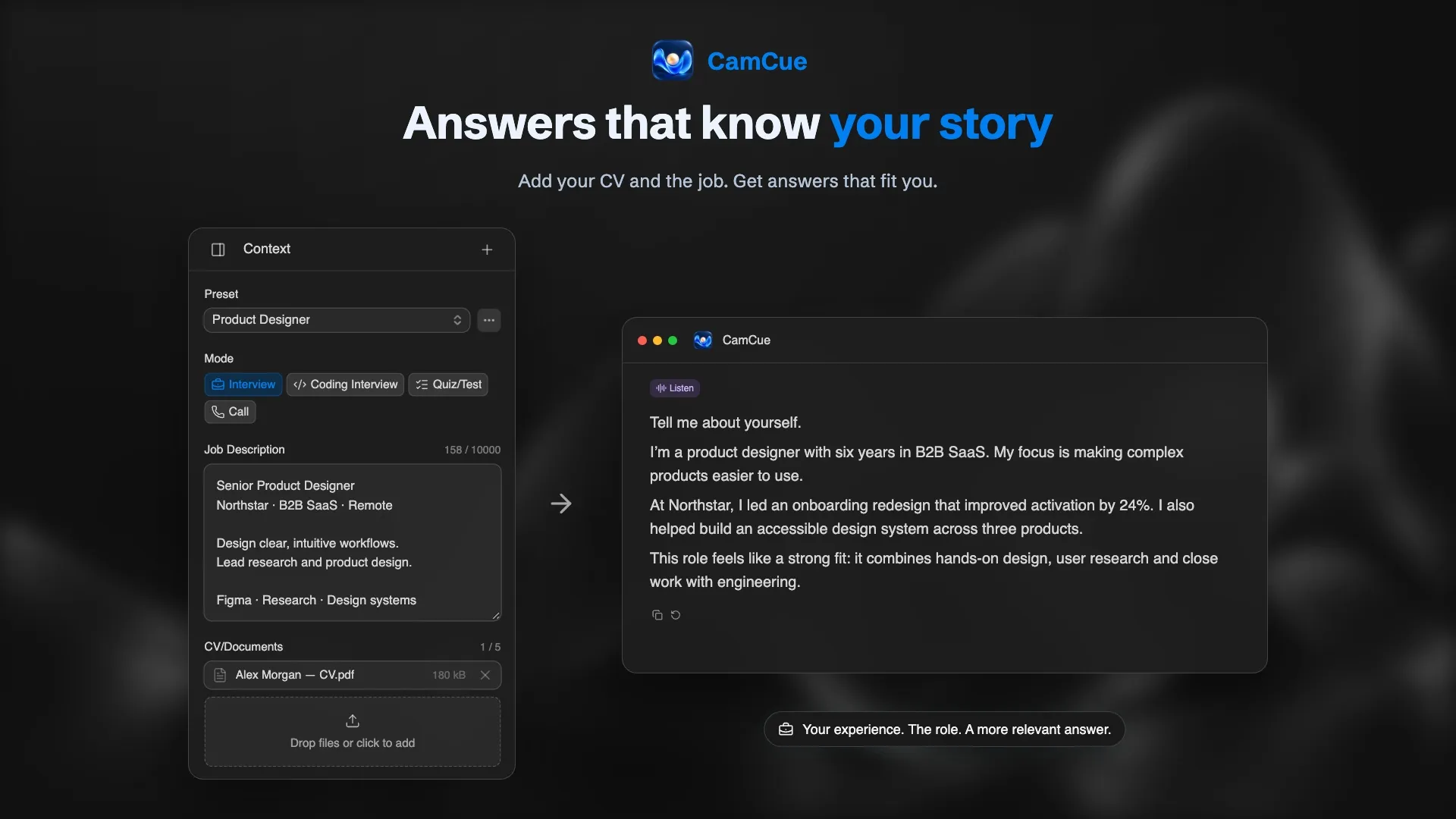
CamCue’s practice demo asks questions aloud and drafts answers from your CV, so you can compare your own answer with a structured version. See the AI interview copilot for details.