
“Tell me about yourself” is usually the first question in an interview, and it sets the tone for everything after it. The interviewer is not asking for your life story. They want a 60 to 90 second summary that shows who you are professionally, what you have achieved, and why this role makes sense for you.
What the interviewer really wants to know
Behind the open question are three specific ones:
- Can you do this job? Your current role and most relevant experience.
- Have you done it well before? One or two concrete results.
- Why here, why now? How this role fits where you are going.
A good answer covers all three in that order and ends with a natural hand-off to the next question.
A simple structure: present, past, future
| Part | What to say | Length |
|---|---|---|
| Present | Your current role, scope, and what you are known for | 1–2 sentences |
| Past | One or two achievements that match the job, with numbers | 2–3 sentences |
| Future | Why this role and company are your next step | 1–2 sentences |
Start with the present because it is what the interviewer cares about most. Use the past to prove it. Finish with the future so the conversation moves toward the role.
Example answers by role
Software engineer
I’m a backend engineer with five years of experience, currently at a fintech company where I own our payments API. Last year I led the migration from a monolith to three services, which cut checkout latency by 40 percent and let two teams deploy independently. I’m looking for a role with more ownership of system design, and your work on real-time fraud detection is exactly the kind of problem I want to spend the next few years on.
Product designer
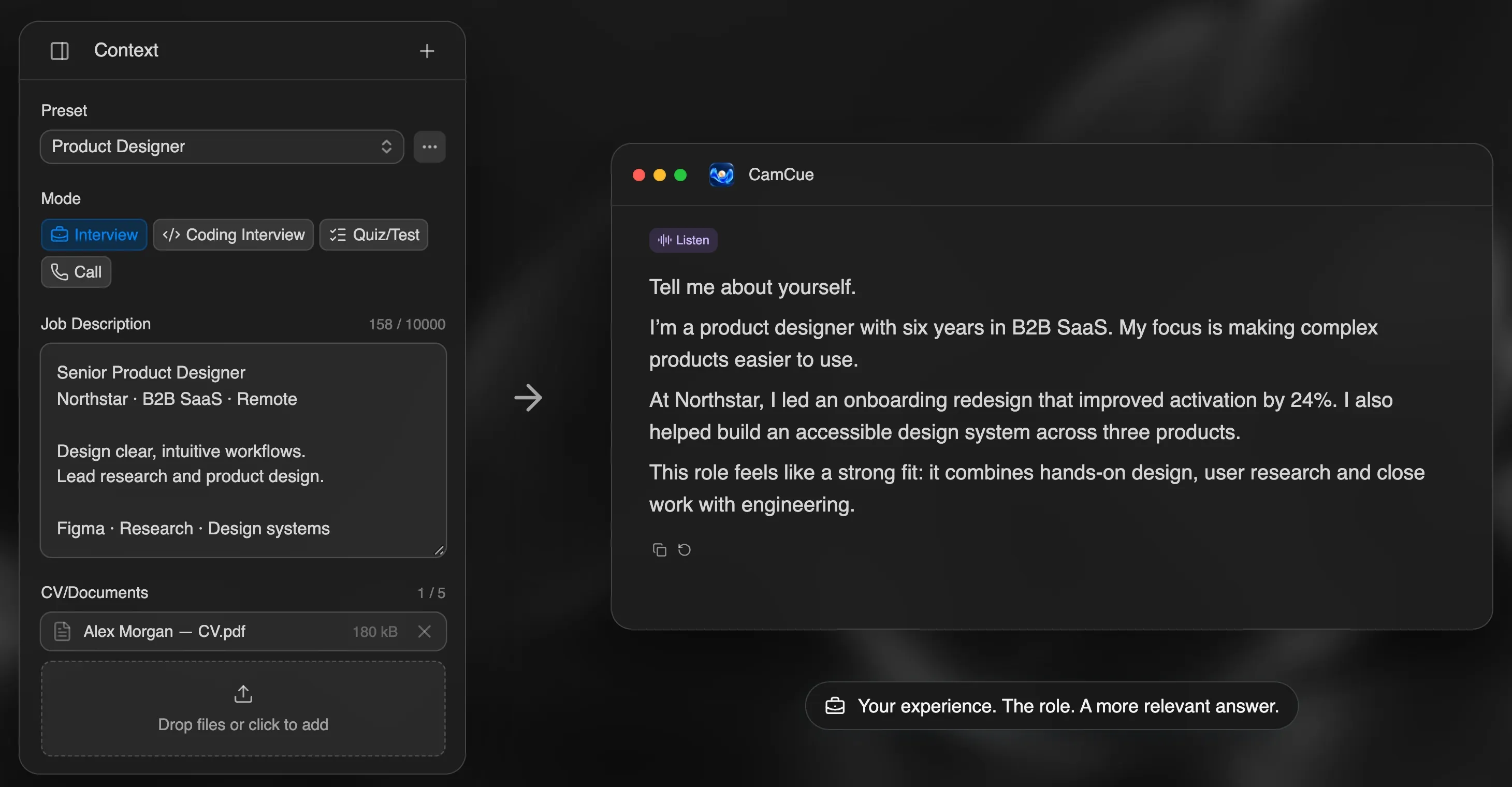
I’m a product designer with six years in B2B SaaS. My focus is making complex products easier to use. At my current company, I led an onboarding redesign that improved activation by 24 percent, and I helped build an accessible design system used across three products. This role stands out to me because it combines hands-on design with research and close work with engineering.
Sales or customer success
I’m a customer success manager responsible for about 60 mid-market accounts. I focus on onboarding and expansion: last year my book of business had 112 percent net revenue retention, and I built a training program the team now uses for every new customer. I’m excited about this role because you are moving upmarket, and I have spent the past two years helping customers through exactly that transition.
Career changer
I spent seven years as a high school math teacher, and for the last two I have been moving into data analysis. I completed a SQL and Python program, and I built a dashboard that our district now uses to track attendance across 14 schools. What I enjoyed most in teaching was explaining numbers so people act on them, which is why this analyst role, working closely with operations teams, feels like a natural next step.
Recent graduate
I just graduated in computer science, where I focused on human-computer interaction. During my internship at a health startup, I shipped a medication reminder feature that is now used by about 8,000 patients, and I ran the usability tests behind it. I’m applying for this junior product role because I want to keep working where engineering and user research meet.
Common mistakes
- Reciting your whole CV. The interviewer has already read it. Pick what matters for this job.
- Starting with your childhood or education. Unless you are a recent graduate, start with your current role.
- No numbers. “Improved activation” is forgettable; “improved activation by 24 percent” is not.
- A generic ending. “I’m looking for new challenges” says nothing. Name something specific about the role or company.
- Going over two minutes. Leave room for the interviewer to ask follow-up questions.
How to build your answer from your CV and the job description
The fastest way to a strong answer is to match your CV against the job description:
- Highlight the top three requirements in the job description.
- For each one, find a line in your CV that proves it, ideally with a number.
- Pick the strongest one or two for the “past” part.
- Write one sentence on why this company, using something specific from the job post or the company’s product.
- Say it out loud and trim it to under 90 seconds.
CamCue can speed up the first draft. In Interview mode, add your CV and paste the job description. When you practice with the built-in demo or hear the question on a call, CamCue drafts an answer that connects the experience in your CV to the requirements in the job post.
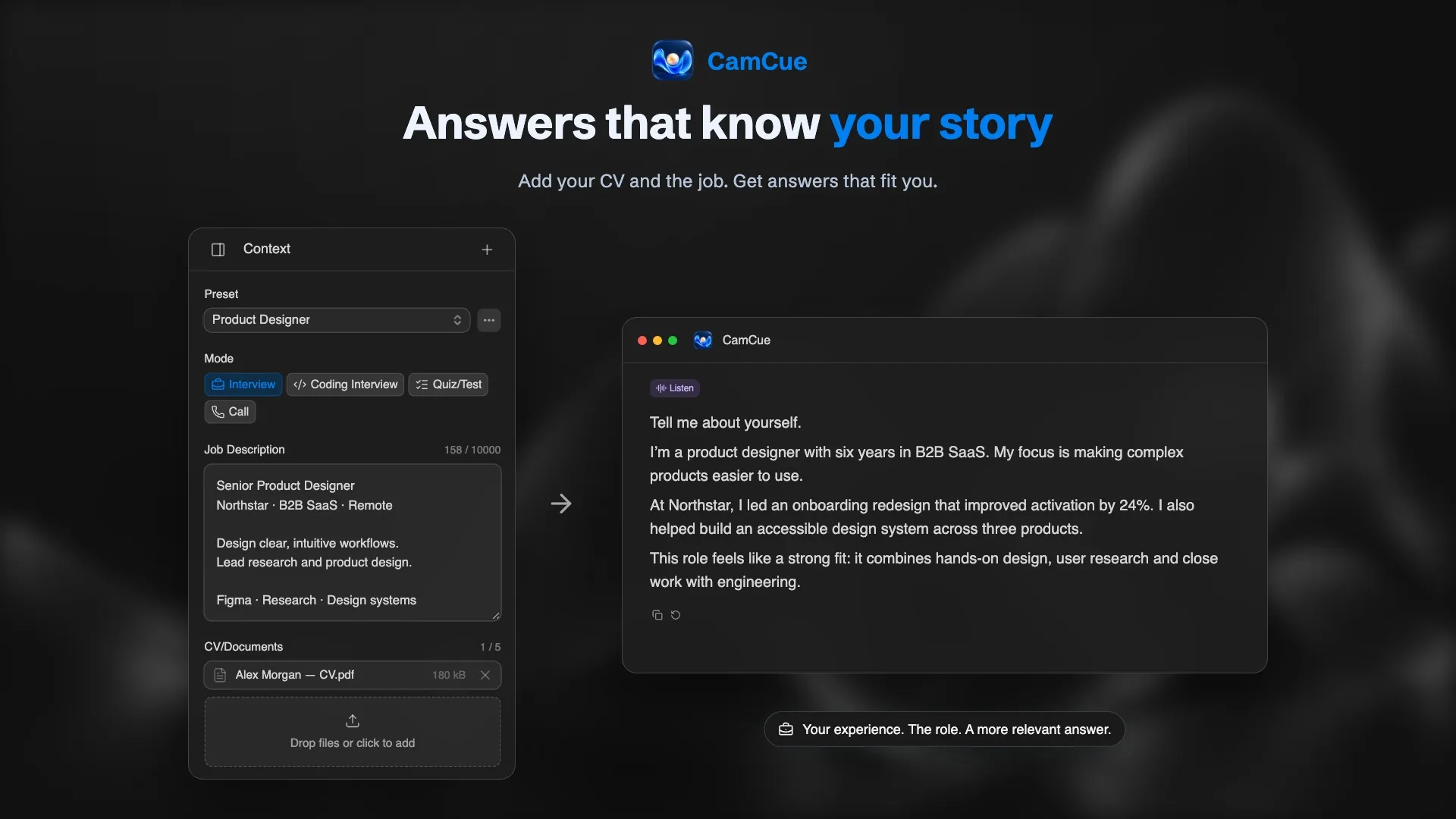
Treat the draft as raw material: check every fact, replace phrases that do not sound like you, and practice until you can say it without reading.
Practice it out loud
Writing the answer is half the work. The other half is saying it under mild pressure:
- Record yourself on your phone and listen back once.
- Practice with a friend who interrupts you halfway through.
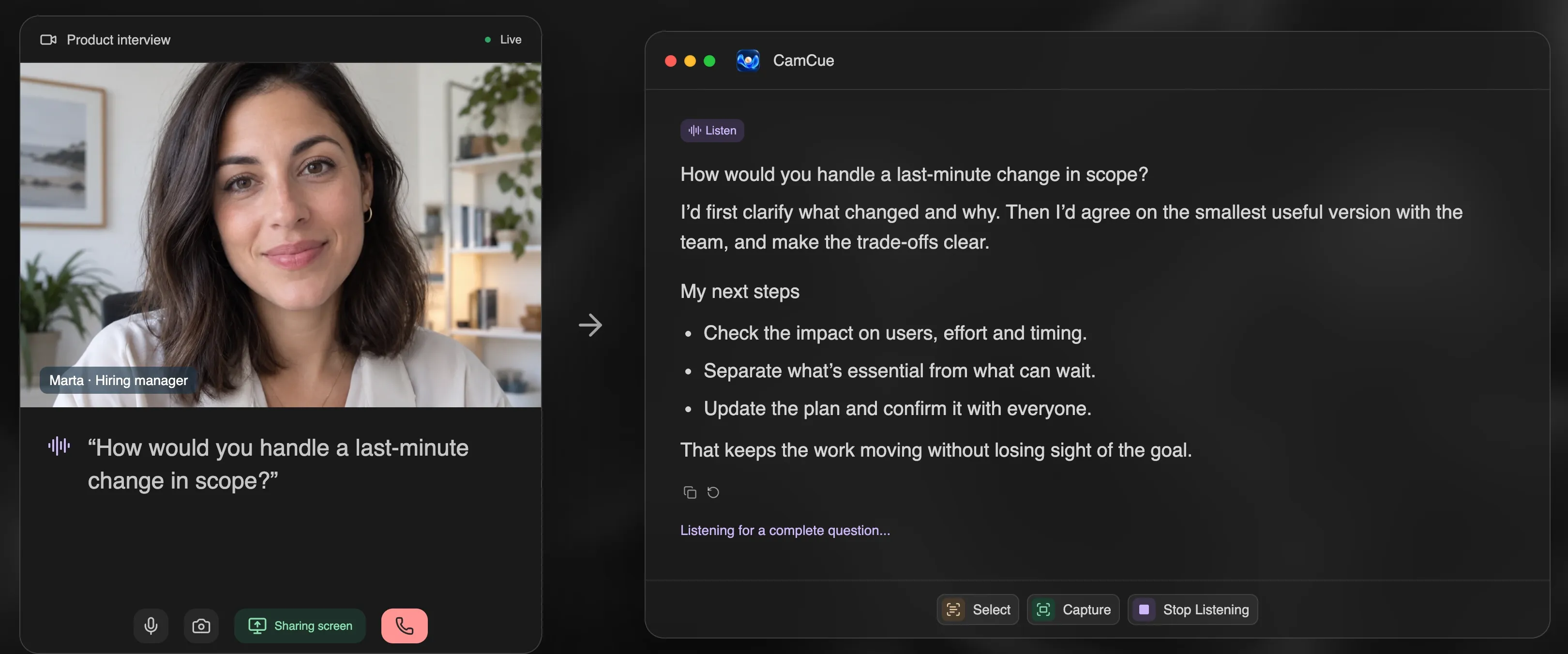
- Use a mock-interview tool. In CamCue, choose “No call? Try a demo” to hear interview questions spoken aloud and compare your answer with a draft built from your context.
A template to fill in
I’m a [role] with [years] of experience in [industry or domain], currently [what you own or are known for]. Recently, I [achievement with a number], and [second achievement or skill that matches the job]. I’m interested in this role because [specific reason tied to the company or team].
Fill it in, read it aloud, and cut anything that does not help the interviewer decide that you fit this job.