
“What is your greatest weakness?” is not a trap. The interviewer wants to know whether you see yourself clearly and whether you do something about your gaps. A good answer is honest, specific, and mostly about improvement.
What the interviewer is really asking
- Self-awareness: can you name a real weakness without getting defensive?
- Risk: is the weakness a problem for this particular job?
- Growth: what have you done about it, and is it working?
A two-part structure
| Part | What to say | Length |
|---|---|---|
| 1. The weakness | Name it plainly and give one short, real example of how it showed up | 2–3 sentences |
| 2. The fix | What you changed, how you track it, and the result so far | 2–4 sentences |
Spend about a third of your answer on the weakness and two thirds on what you are doing about it.
How to choose the right weakness
- Make it real. Interviewers can tell when a strength is dressed up as a weakness.
- Keep it away from the core of the job. An accountant should not say “attention to detail”; a salesperson should not say “talking to strangers.”
- Pick one you are already working on, so you have something concrete to describe.
- Avoid character flaws such as dishonesty, laziness, or trouble with authority.
Example answers
Delegating (team lead or senior role)
I used to hold on to tasks I could do faster myself. When I started leading two engineers, that made me the bottleneck before a release. Since then I write a short brief for anything that takes more than half a day and hand it off by default. Last quarter my team shipped two features I only reviewed, and both went out on time.
Public speaking (analyst or engineer)
Presenting to large groups has not come naturally to me. In my last role I noticed I was letting my manager present work I had done. I joined our internal demo rotation and now present once a month. It is still not my favorite thing, but I am clear and prepared, and I got good feedback on my last quarterly review.
Saying yes to everything (project manager)
I tend to say yes to every request, which once stretched me across too many projects at the same time. Now I check every new request against the team’s current priorities and offer a date or a trade-off instead of an automatic yes. It has made my commitments more reliable.
Getting lost in details (designer or researcher)
I can spend too long perfecting work that only needs to be good enough, like internal documents. I now set a time box before I start and ask who the audience is. That saves me several hours a week for the work where detail really matters.
Asking for help late (junior or new graduate)
I sometimes struggle alone for too long before asking for help. During my internship I lost a day on a setup issue a teammate solved in ten minutes. Now I give myself a fixed amount of time, usually an hour, and then ask with a clear summary of what I have tried.
Direct feedback (customer success or sales)
I used to soften feedback so much that the message got lost. A customer once missed that their renewal was at risk because I was too indirect. I now state the main point in the first sentence and follow with context, and I practice difficult conversations with my manager before important calls.
Technical depth in a new area (career changer)
I am newer to SQL than people who started their careers in data. I am closing the gap with a weekly practice routine and by building the reports my current team needs. Three months ago I needed help with joins; now I write and review queries for our weekly dashboard.
Impatience with slow processes (operations)
I can get impatient when a process is slower than it needs to be, and early on I pushed changes before everyone was on board. I learned to bring data and a proposal first. My last process change took two weeks longer to agree on but stuck, because the team helped design it.
Weaknesses and phrases to avoid
- “I don’t have any weaknesses.”
- “I work too hard” or “I care too much.”
- “I’m a perfectionist” without a concrete example.
- A weakness that is a core requirement of the job.
- Anything personal that is unrelated to work.
Variations of the question
Interviewers often ask the same thing in different words. The structure above works for all of them:
- “What would your last manager say you need to improve?”
- “What is something you are working on right now?”
- “Tell me about a piece of feedback that was hard to hear.”
- “What do you find most challenging in your work?”
Practice until it sounds natural
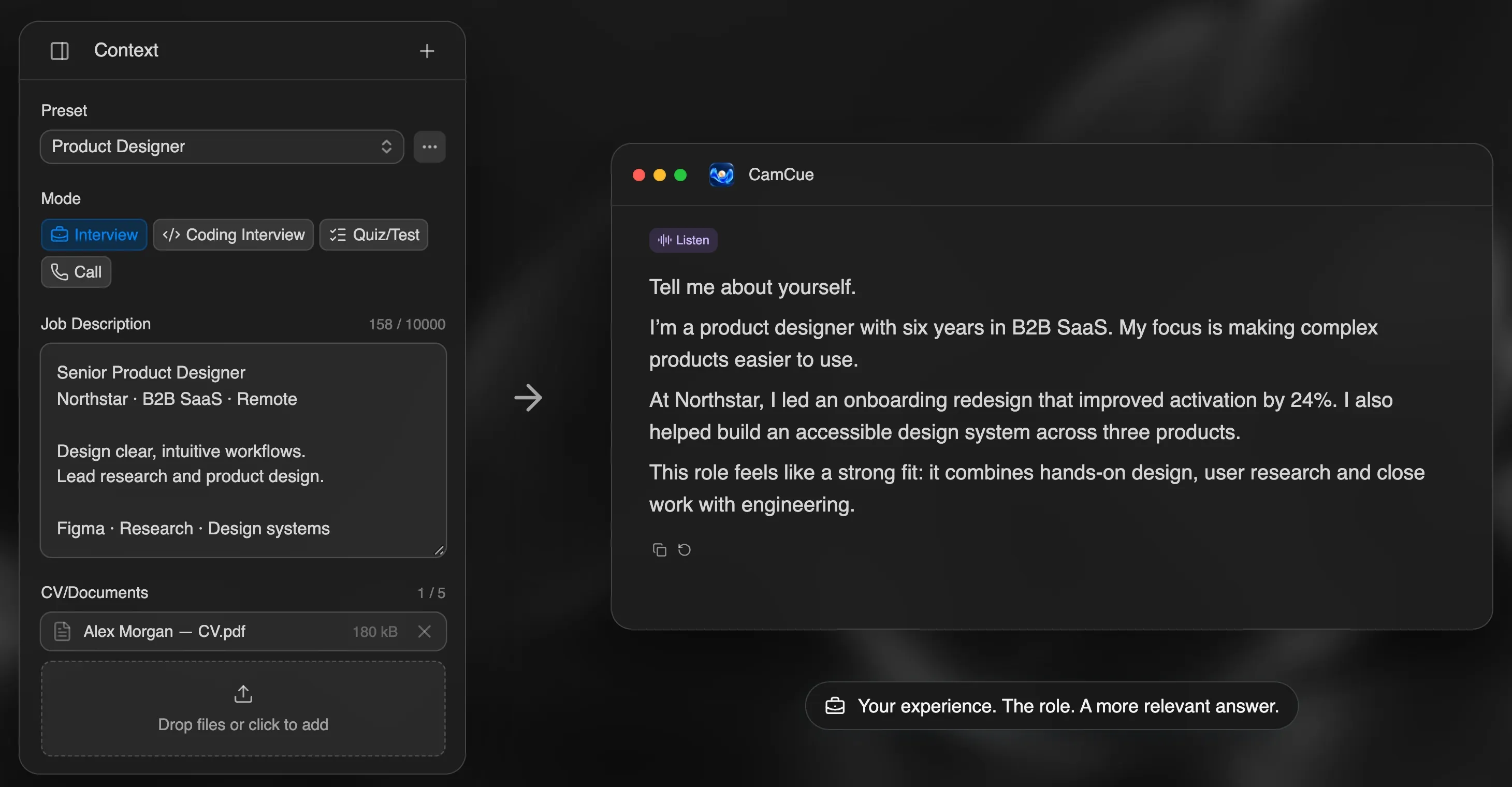
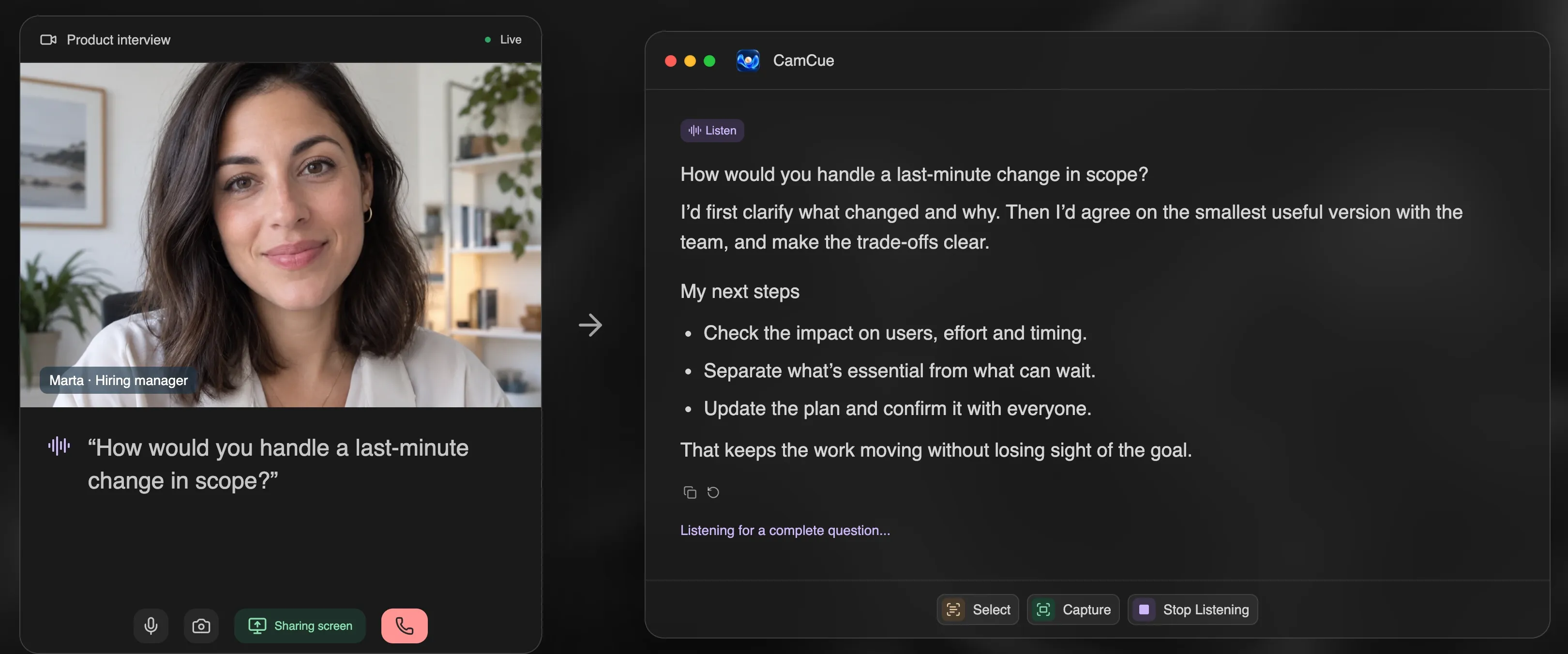
Write your answer, read it aloud, and cut it to about a minute. Then practice with spoken questions so it does not sound memorized. In CamCue, add your weakness and the steps you have taken to your context instructions, then run the practice demo. The draft answer will use your own wording and examples, which makes it a useful reference to compare against.
If you are preparing several stories, structure each one with the STAR method, and start your interview strong with a clear answer to “Tell me about yourself”.