
Behavioral questions like “Tell me about a time you disagreed with your manager” are designed to find out how you actually work. The STAR method gives every answer the same clear shape, so you stay concrete, keep it short, and end with a result.
What STAR means
| Letter | What to cover | Share of your answer |
|---|---|---|
| S — Situation | Where and when, in one or two sentences | ~15% |
| T — Task | What you were responsible for, or the problem to solve | ~10% |
| A — Action | What you did, step by step, and why | ~55% |
| R — Result | The outcome, with numbers if possible, and what you learned | ~20% |
The most common mistake is spending half the answer on the situation. The interviewer cares most about your actions and the result.
A fill-in template
Situation: At [company], [short context].
Task: I was responsible for [goal or problem].
Action: I [first action], then [second action], and [third action], because [reason].
Result: As a result, [measurable outcome]. I learned [one lesson].
Six example answers
1. Conflict with a colleague
Question: Tell me about a time you disagreed with a teammate.
S: On a checkout redesign, our lead engineer and I disagreed about removing a step from the flow. T: I needed us to agree before the sprint started. A: Instead of debating opinions, I suggested a one-week A/B test, wrote the test plan with him, and agreed in advance what result would settle it. R: The shorter flow increased completed purchases by 6 percent, he championed the change in the review, and we now use quick tests to settle design debates.
2. A mistake or failure
Question: Describe a time you made a mistake.
S: In my second month as an analyst, I sent a weekly revenue report with a filter error. T: I had to correct it before leadership made decisions on it. A: I told my manager within the hour, sent a corrected report with a one-line explanation, and added an automated check that compares totals with the previous week. R: No decisions were affected, and the check has caught two data issues since. I learned to build verification into the process instead of relying on attention.
3. A tight deadline
Question: Tell me about a time you worked under pressure.
S: Two weeks before a trade show, our demo environment failed a load test. T: I owned getting it stable in time. A: I listed the failure points, cut two non-essential features from the demo, and paired with a backend engineer on caching for three days. R: The demo handled 4 times the expected traffic and the sales team booked 40 meetings at the event.
4. Leadership without authority
Question: Give me an example of when you led a project.
S: Our support team kept getting the same billing questions after every release. T: Nobody owned the problem, so I volunteered to fix it. A: I gathered the top ten questions, worked with product to update in-app copy, and created a release checklist that includes a support review. R: Billing tickets dropped by 35 percent over the next quarter, and the checklist became standard for every release.
5. A difficult customer
Question: Tell me about a time you handled an unhappy customer.
S: A large customer threatened to cancel after a week of slow responses during an outage. T: I was asked to keep the account. A: I called the customer the same day, acknowledged the problem without excuses, set up daily updates until the fix shipped, and arranged a call with our engineering lead. R: They renewed for two years, and the daily-update practice became our playbook for major incidents.
6. Ambiguity
Question: Describe a situation where the requirements were unclear.
S: I was asked to “improve onboarding” with no specific goal. T: I needed to turn that into a measurable project. A: I analyzed where new users dropped off, interviewed eight of them, and proposed one goal: increase week-one activation. R: We redesigned the first session and activation rose from 31 to 39 percent in two months.
Common STAR mistakes
- Too much Situation. Keep the setup to two sentences.
- “We” instead of “I.” Credit the team, but explain your part.
- No result. Always end with an outcome, even an imperfect one, and what you learned.
- No numbers. Percentages, time saved, money, or counts make results believable.
- Memorized scripts. Know the points, not every word.
Build a story bank
Prepare five to eight stories and map each to several common themes:
| Story | Conflict | Failure | Pressure | Leadership | Customer |
|---|---|---|---|---|---|
| Checkout A/B test | ✓ | ✓ | |||
| Report error | ✓ | ||||
| Trade show demo | ✓ | ✓ | |||
| Billing tickets | ✓ | ✓ |
One good story can answer three or four different questions.
Prepare your stories with your CV and the job
Pick the stories that prove the top requirements in the job description. In CamCue, add your story notes and an instruction such as “Structure examples with STAR” to your Interview context, along with your CV and the job description.
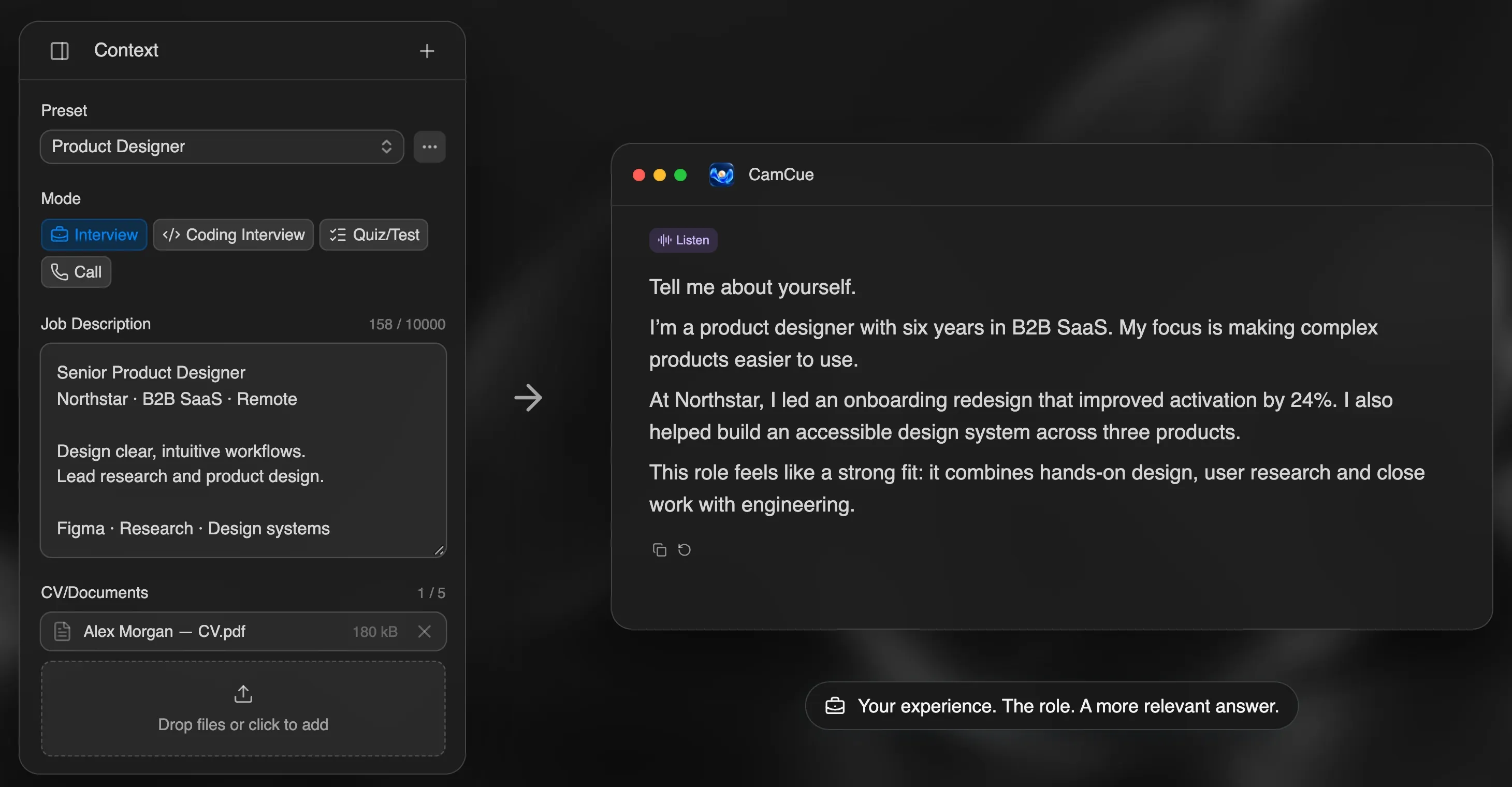
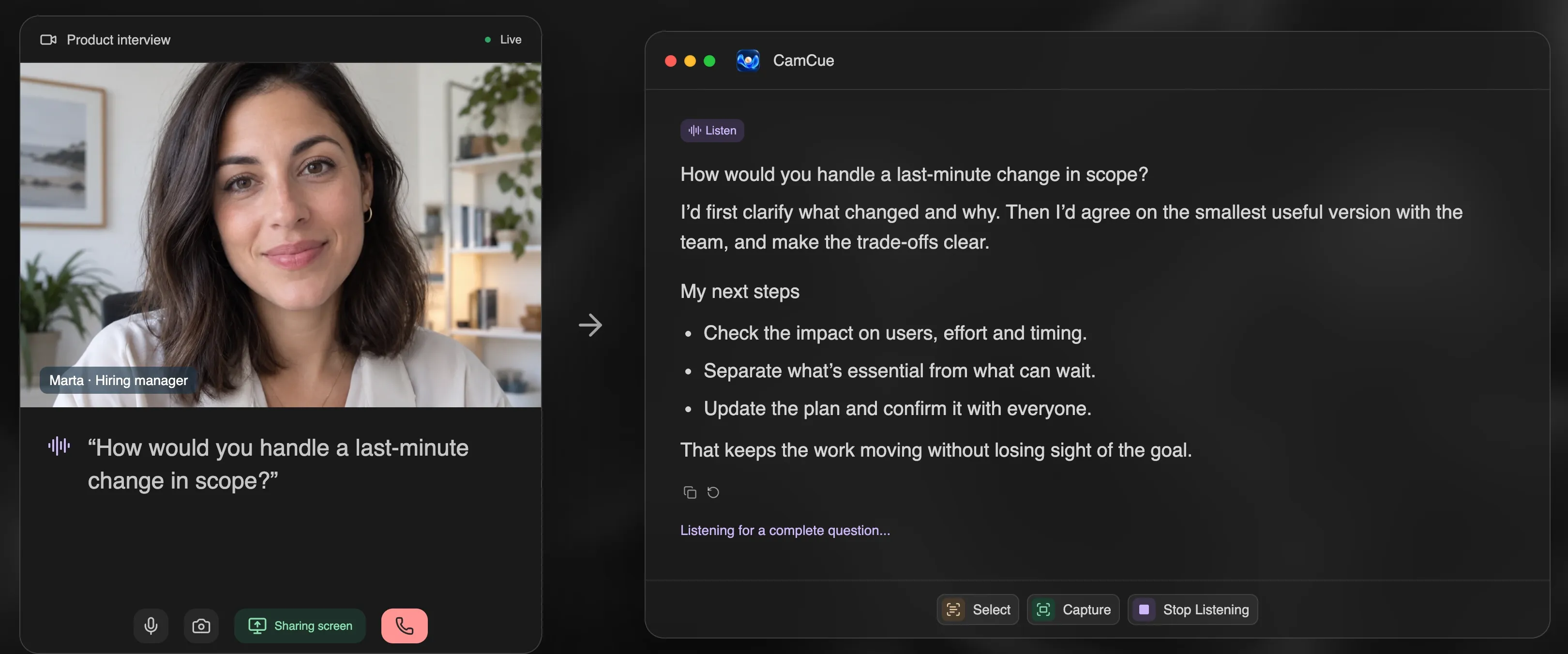
Then rehearse with the practice demo, which asks questions out loud. Answer first, then compare your answer with the draft: did you include the result? Did you say “I”?
Strong STAR stories also make follow-up questions easy, because every detail is real. That matters more than any tool, as we explain in Can interviewers tell if you are using AI?