

Short answer: using AI to prepare is not cheating, and using it during an interview is cheating when the employer says not to. The difficult cases are the ones in between, where nobody said anything. This guide explains how employers draw the line and how to find out where it is for your interview.
Disclosure: CamCue is our product, and it can be used during live calls. We think it should be used where assistance is allowed and for practice, and this guide is written with that in mind.
Preparation is fair game
Almost every employer accepts AI as a preparation tool. Anthropic’s guidance for candidates is a clear example: it encourages candidates to use AI to research the company, practice answers, and prepare questions, while asking them to complete take-home assessments and live interviews without AI unless told otherwise.
Fair uses of AI before an interview include:
- turning your work history into clear stories with the STAR method;
- rehearsing common questions out loud and getting feedback;
- researching the company, the team, and the role;
- preparing questions to ask the interviewer.
Live help depends on the rules
During the interview itself, rules vary by company and by format.
| Situation | Usually allowed? |
|---|---|
| Practice sessions and mock interviews | Yes |
| Notes you wrote yourself, open during a video call | Often, but ask |
| AI help in a live interview, when the employer allows it | Yes |
| AI help in a live interview, when the employer forbids it | No |
| Online coding assessments and take-home tests with stated rules | Follow the stated rules; most forbid outside help |
| Proctored tests | No, unless explicitly permitted |
Some employers state their position in writing. Amazon’s recruiting guidance asks candidates not to use generative AI tools during interviews unless explicitly permitted and warns that breaking the rule may lead to disqualification. Other companies allow AI in interviews for roles where using it is part of the job.
When nobody tells you
If the rules are not stated, assume live help is not expected, and ask. A one-line message to the recruiter is enough:
“Are candidates allowed to use notes or AI tools during this interview, or should I rely only on my own preparation?”
The answer protects you either way. A recruiter who allows notes or AI has told you so in writing. A recruiter who does not has saved you from a disqualification.
Why honesty matters more than detection
Interviewers rarely prove that someone used AI. They notice when answers fall apart under follow-up questions, as we describe in how interviewers detect AI help. But being undetected is not the same as being allowed. Undisclosed help discovered later, during reference checks or in the first weeks of the job, can cost an offer or the job itself.
The more useful question is whether the answer is yours. AI that helps you remember and structure your real experience produces answers you can defend. AI that invents experience produces answers that collapse at the first “Tell me more.”
How CamCue fits
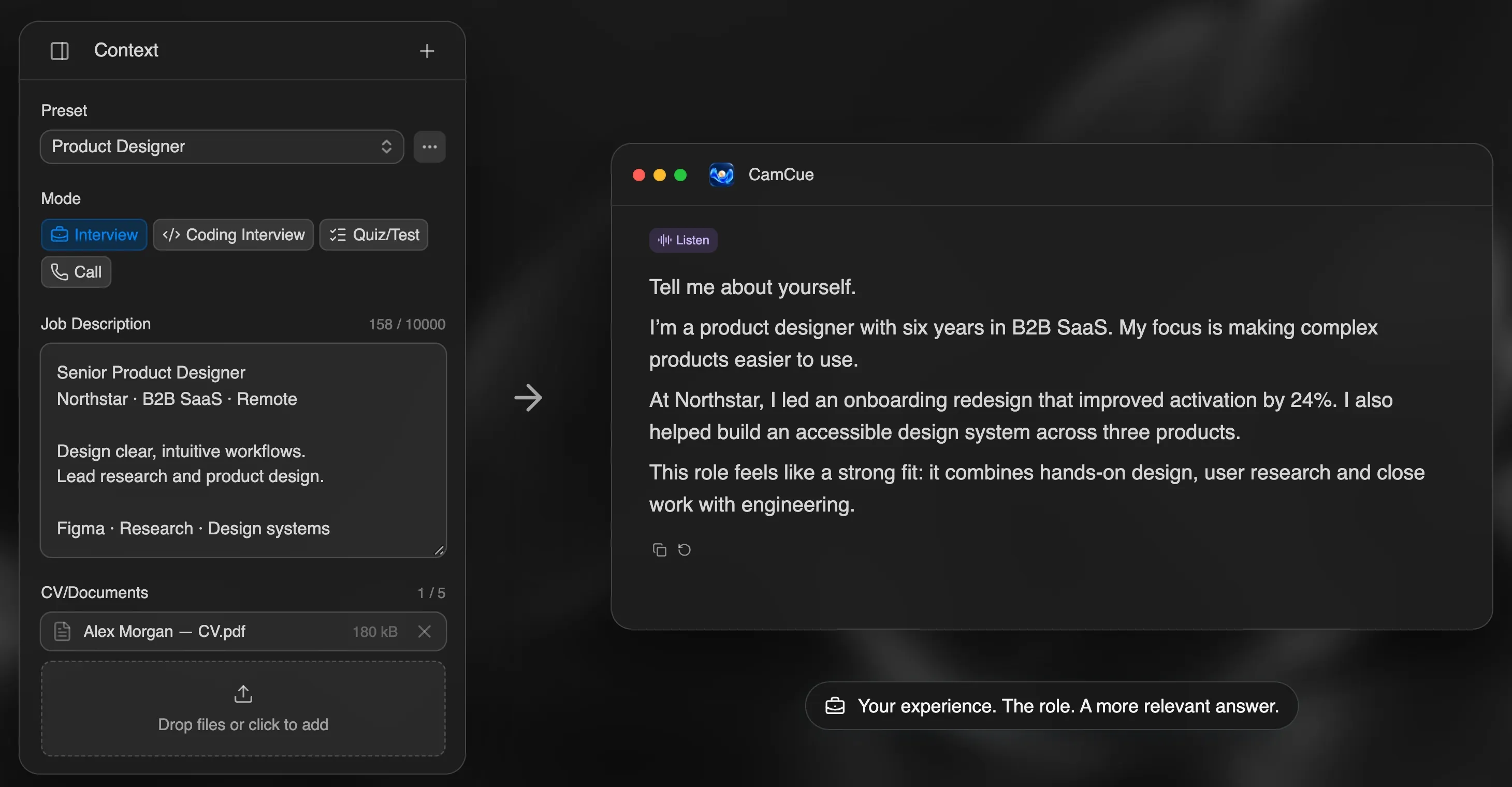
CamCue builds drafts from the CV, documents, and job description you provide, so the details come from your own experience. Its practice demo asks spoken questions so you can rehearse before any real call. Use it freely for practice, and in live conversations only where assistance is permitted. More on how it works in the AI interview copilot overview.
Bottom line
- Preparing with AI: fine everywhere.
- Using AI live: fine only when the employer allows it.
- Unsure: ask, and keep the answer in writing.